
Tips from a physician for communicating health
San Antonio, Texas — Given the abundance of health information available online and through technology, patients and clients are asking complex questions about their health that are pushing health professionals and community health workers to sharpen their health communication skills.
Some common questions may include, “‘My father had a thyroid problem. I assume I’ll have one as well. Should I get tested? Or everyone in my family has had a bad reaction to vaccines. Will I have a bad reaction?,’” said Matt Dacso, MD, MSc, FACP, director of the Charles E. Cheever Jr. Center for Medical Humanities & Ethics and professor of medicine.
Today it’s not unusual for a health talk to touch upon genetics, environment, lifestyle, and testing, and how they all interact to influence health, he added.
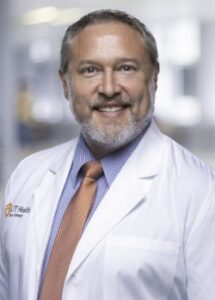
As such, there is a growing need for health communication strategies to help professionals navigate this complex information environment, Dacso said. He tackled the topic in a Health Confianza ECHO presentation titled, “Genetics are Not Always Destiny – Communicating the Complex Relationship Between Nature and Nurture.”
“We have greatly expanded our knowledge about what genetics, what our DNA, does for our bodies and what it does for our risk (for disease),” Dacso said. “And we also are constantly learning more about how lifestyle, how environment, how socioeconomic conditions play with the DNA and affect our bodies in a way that actually can cause health conditions to integrate into our health and our next generations.”
Technology and its rapid evolution are also adding complexity.
“This influx of health information can be very hard for our patients, clients or members of the community who are just trying to figure out what to do for their health,” he said.
What this means for health providers/community health workers
Today, conversations around health require layered and thoughtful consideration of multiple factors: genetics (individual genes and inheritance), genomics (the interaction of multiple genes and environmental factors), as well as the role of social determinants of health, Dasco said.
“We have to figure out how to communicate with our community about how complex this is,” he said.
When weighing risks for certain diseases and illness and assessing the next steps, experts look at social determinants, such as stress.
“We know from adverse childhood events literature that there are potential limitations or delays in developmental milestones for youth that are living in poverty or in situations of lower socioeconomic status,” he said.
It’s also important to recognize that when a health professional is talking about what the environment is doing to an individual’s genes, they are discussing Epigenetics — the study of how environmental stressors (such as diet, stress and toxins) can turn on or off certain genes influencing development, health, and disease, he said.
“The point here is not that we need to be experts in genetics. It’s to show that there’s actual science behind what people say and what they feel,” Dacso added.
While some diseases are purely genetic, including sickle cell and Huntington’s disease, other health conditions illustrate varying degrees of genetic and environmental influence— complex conditions like diabetes, cancer, and autoimmune disorders.
Another consideration for health practitioners is that patients and clients are on the receiving end of a flood of health information from technology and AI platforms.
For instance, direct-to-consumer genetic testing has yielded unprecedented access to health information, which offers individuals empowerment but also raises concerns about interpretation, cost, and privacy.
Even with the availability of health information, health providers should keep in mind that the average health literacy level in the U.S. is low. A large majority of adults (around 88%) at some point struggle with tasks like understanding medication instructions or health insurance information.
How to communicate uncertainty and risk effectively
When having conversations with patients and clients, it’s good to point out that medicine is inherently uncertain, said Dacso, quoting William Osler: “Medicine is a science of uncertainty and an art of probability.”
“When you are transparent about what is known, unknown, and subject to change, you are able to build trust,” Dacso said. “The main message is that patients can understand uncertainty if it is explained honestly and clearly.”
People accept risks more readily when they understand the benefits and are part of a shared decision-making process.
“They want to make the best decisions for themselves or, when caring for others, for their loved ones. But the amount of information can feel overwhelming,” Dacso said.
Overall, Dacso said, “Have awareness, empathy, humility, transparency, and then empower the people who are around us.”
Watch Dacso’s video here and see tips and resources below.
Practical communication strategies from Dr. Dacso include:
Present information in multiple formats — (e.g., percentages and frequencies), avoiding framing bias, and using relatable denominators (e.g., “1 in 10” instead of “1 in 10,000”).
Remember, less is more — avoid overwhelming patients with technical details unless they ask. Emotional factors often distort risk perception, so empathy and reassurance are key.
Use Visual tools like the Swiss cheese model, which was popularly used to explain the COVID-19 pandemic, and simple risk charts to help make complex concepts understandable.
Plain language Definitions:
Source: Justplainclear.com
Genetics – The study of how parents pass certain genes to their children
DNA – A tiny substance that has instructions for making every part of you
mRNA vaccine is also known as: messenger RNA vaccine — A new type of vaccine to protect against infectious diseases where parts of your DNA (chemical makeup of cells) are taught how to create a protein
Social Determinants – Also known as: health disparities
Conditions that may influence a person’s risk for developing health problems and health outcomes. Social determinants of health include where a person: lives, works, learns and plays
Resources:
Personalized risk calculators to support informed decision-making
– American Heart Association: https://professional.heart.org/en/guidelines-and-statements/prevent-calculator
-NIH Breast Cancer Assessment Tool: https://bcrisktool.cancer.gov/