San Antonio, Tx — Imagine engaging with a community and rapidly learning what people are thinking and feeling about their health and well-being.
As a core function of public health, the capacity to quickly turn data into action is highly valued, but often difficult to realize. At least until now.
Health Confianza is piloting a technological solution called the Community Microphone that allows people to record responses to questions in real time using a cellphone. Their responses are then automatically transcribed and summarized using AI. Public health professionals can further use AI to analyze these data in real time to draw insights, ask questions, and find common themes among responses.
“Although the health priorities and determinants may be similar across Bexar County, each community has its own strengths and challenges that must be acknowledged,” said Jason Rosenfeld, DrPH, MPH, CHWI, co-director of Health Confianza, director of Global Health, The University of Texas at San Antonio. “The Community Microphone gives us a way to hear directly from community about their concerns and solutions, in a non-intrusive way, so that we as public health professionals can better, and more rapidly, tailor our interventions.”
The tool helps reduce the time and manpower typically needed for community assessments using traditional data collection methods like surveys or focus groups. Because this system is automated, the microphone can be used anywhere, anytime, and eventually, in any language.
However, as with any new strategy, there are challenges to consider. Community health workers, who shared the community mics via a QR code on flyers, said that it can be difficult for phone microphones to record responses in noisy environments, such as health fairs. Additionally, the technology only records voice, which may be difficult for those who have difficulty speaking. Lastly, not all community members have access to smart phones.
Health Confianza partnered with Flourish, a Houston-based data analytics company, on the community microphone, which is one tool in a Salesforce-powered dashboard created to collect, manage, share and visualize program data. The company offers the community microphone tool as part of a dashboard, or it can be purchased separately.
“Together, Health Confianza and Flourish are identifying best practices around the use of the voice-based data collection and AI analysis via the community microphone tool in public health settings. We are excited to see how this tool can be replicated in other communities and brought to scale for the purpose of centering community voice in programs aimed at improving health and wellness,” said Aaron Godoy, co-founder, CTO, CEO at Flourish.
Community Mic Drop
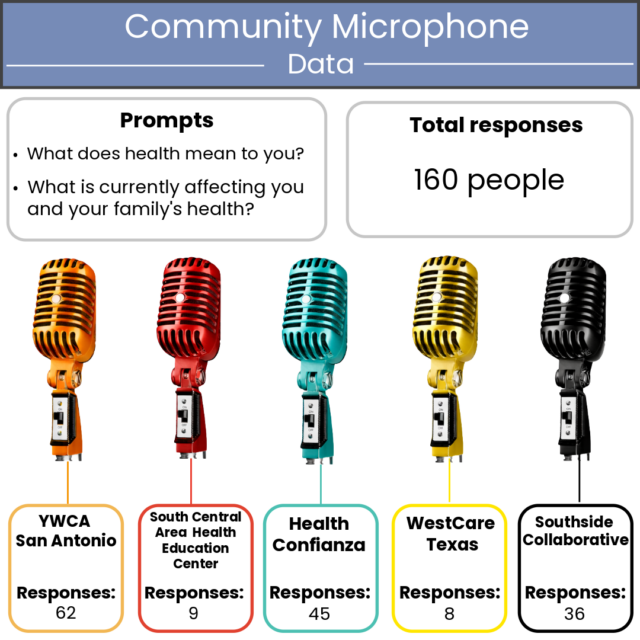
In April of last year, Health Confianza and its partners —South Central Area Health Education Center (AHEC), Southside Collaborative, WestCare Texas, and YWCA San Antonio —launched the first community microphone with two simple prompts in English and Spanish.
- What does health mean to you?
- What is currently affecting you and your family’s health?
From April through May, Health Confianza and its four partners gathered community input at health fairs, club meetings, bulletin boards, etc. These five organizations collected more than 160 responses from people across Bexar County.
Overall, here’s what the respondents said should be addressed to create a healthier community:
- Improved access to nutritious food and healthcare resources
- Community support, education and prevention
- Support to manage chronic health conditions such as diabetes and hypertension
- Safe neighborhoods; freedom from fear of gun violence
- Greater social connections and communal spaces for healthier living
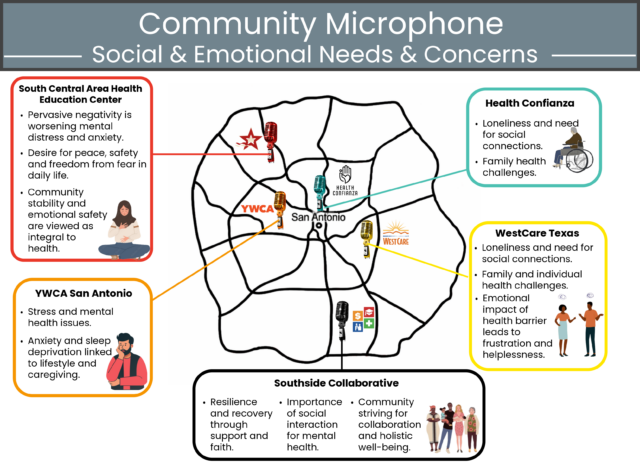
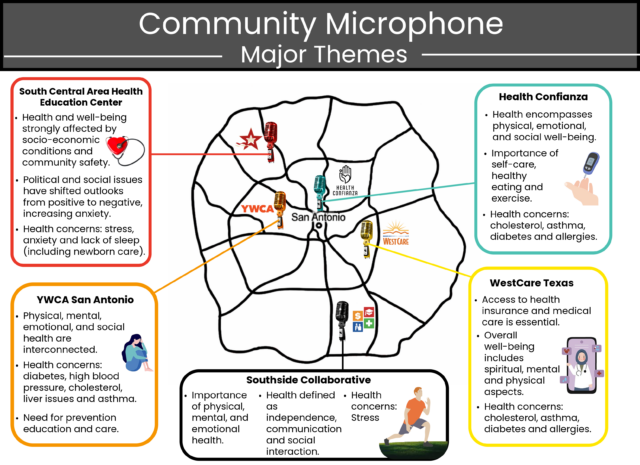
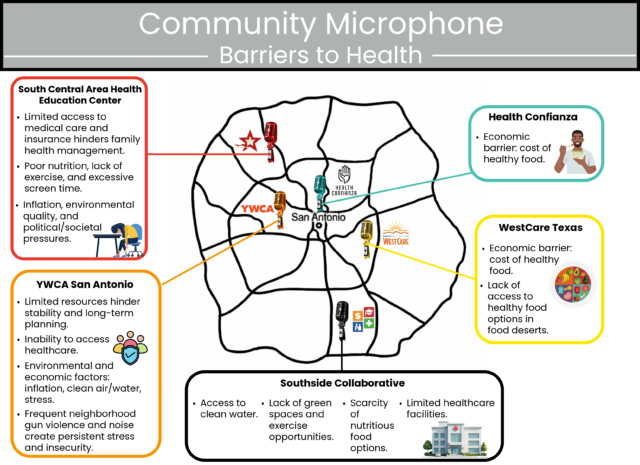
Health Confianza’s team also created three infographics summarizing community responses from San Antonio’s Westside, Southside, Eastside, Central and Northside. The infographics cover three areas: major themes, barriers to health, and social/emotional needs and concerns.
“With this information, we and our partners are able to more rapidly respond to the needs and priorities of the communities we serve. We feel that our tailored responses will contribute to an increase in trust between our organizations and our community, resulting in sustained utilization of our information and services. We are excited to continue centering community voice in our programming via the Community Microphone while seeking additional tools for building and sustaining community trust.” Rosenfeld said.
See the infographics highlighting community voices below.
Major Themes Highlighted by Community
Barriers to Health Noted by Community
Social and Emotional Needs and Concerns from Community