
San Antonio, Texas — In 2025, Health Confianza set out to deliver a virtual learning series on health literacy, a topic that may not be on every health professional’s radar but has the potential to transform how they communicate with patients and clients.
Health Confianza, a health literacy program housed at The University of Texas at San Antonio, provides workforce training, health education, community outreach and health communication services. The program targets health professionals, community health workers, students and others interested in leveraging health literacy best practices to improve the health outcomes of communities.
The web series, titled “Communicating with Confianza – a health literacy ECHO,” attracted more than 270 registrants (an average of 40 participants per session) from Texas and 11 other states, and as far away as Mexico, India and Uganda.
It was delivered in partnership with ECHO® (Extension for Community Healthcare Outcomes), an evidence-based workforce training model that connects specialist hubs with healthcare and public health professionals to improve service delivery through peer to peer and case-based learning .
“Communicating with Confianza is one of our most popular ECHOs to date,” said Jason Rosenfeld, DrPH, MPH, CHWI, co-director of Health Confianza, director of Global Health, The University of Texas at San Antonio. “One reason is that there is a growing understanding of the importance of health literacy in addressing health inequities. Professionals are looking for effective ways to reach people, build trust and create positive experiences. Through this ECHO model, we are able to offer relevant topics, first class presenters, and an interactive format with case study discussions.”
Communicating with Confianza was comprised of two six-part sessions (during the fall of 2025 and concluding in the spring of 2026) designed to provide health literacy training, resources, and knowledge-sharing for Bexar County and surrounding communities.
Health Confianza collaborated with professionals from YWCA San Antonio, South Central Area Health Education Center (AHEC), and the UT Health San Antonio ECHO team to design and deliver the series. Together they formed the ECHO HUB team, a multidisciplinary group of subject matter experts—including specialists, clinicians, and educators.
We asked one member of the ECHO HUB team what she thought the secret was to Communicating with Confianza’s success.
“This ECHO program has really great reach, interaction, and learning,” said Angela Reilly Cruz, senior community outreach coordinator, UT San Antonio, “The conversations are dynamic and engaging. I think what has made it so successful is the community engagement, excellent HUB team, and strong presence that Health Confianza has.”
The ECHO organizers invited presenters from The University of Texas at San Antonio, The University of Texas at Austin, and the San Antonio Nursing Consortium, among other institutions, to speak on health literacy-related topics, including: Shaking the Shame and Blame from Clinical Practice; Use of Plain Language; Bridging the Gap with Teach-Back; and Internet Literacy.
Who logged on?
Besides the topics, another thing that sets the Communicating with Confianza ECHO apart from other training programs is that it drew a diversity of health professionals which led to interesting questions and dialogue. The ECHO drew nurses, caregivers, case managers, elementary school teachers, epidemiologists, primary care physicians, nutritionists, public health officials and more. 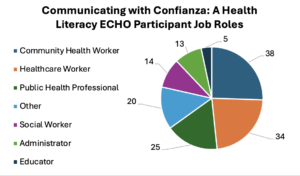
At the end of each session, a volunteer from the community of participants would present a case study for discussion.
“Each real-life case study drew out a rich conversation between participants and a sharing of resources and tools,” said Melanie Stone, DrPH, MEd, co-director of Health Confianza, Assistant Professor of Family & Community Medicine and Director of Community Engaged Learning. “Giving people the platform to discuss real-life challenges is one of the best learning tools at our disposal in healthcare.”
ECHO participants surveyed after sessions were largely impressed with the format and case discussions.
Some of the commenters said they enjoyed learning new information, sharing cases from across the state, receiving new tools such as visual aids, and becoming introduced to new approaches, such as how to interact effectively with patients. Several people complimented the Teach-Back presentation by Melanie Stone, who was also part of the ECHO Hub team.
All sessions are available on the ECHO website: https://wp.uthscsa.edu/echo/echo-programs/communicating-with-confianza-a-health-literacy-echo/