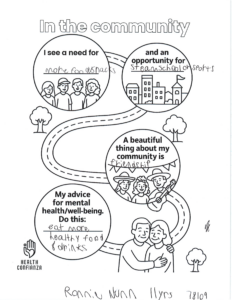
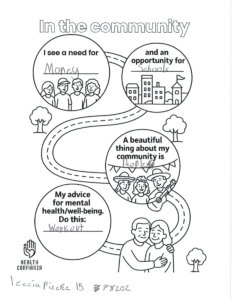
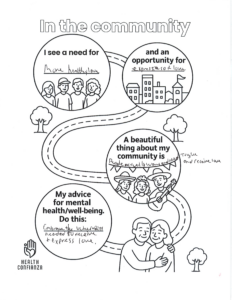
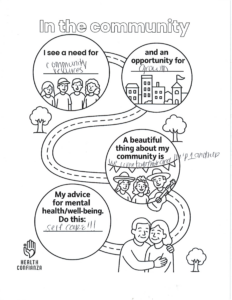
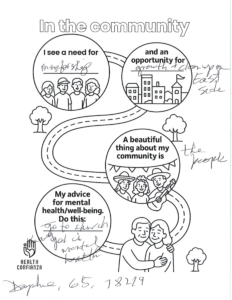
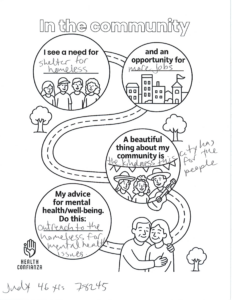
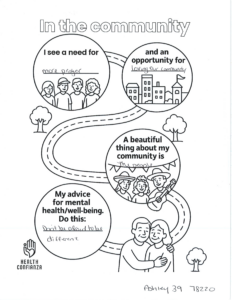
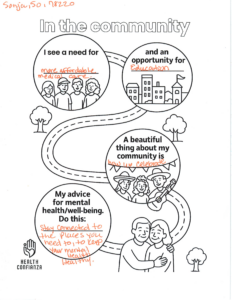
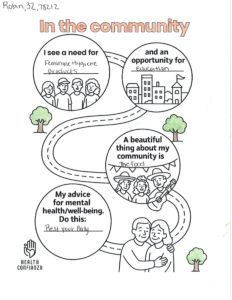
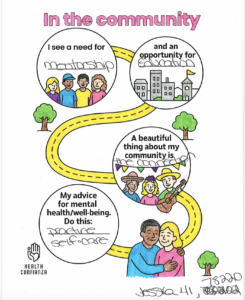
San Antonio, Texas — Health Confianza created a Mad Lib-style fill-in-the-blank coloring sheet for adults and kids. The simple activity has taken off in our community. Feel free to download the “In the Community” coloring sheet for your own communities, and check out some of the responses from our partner WestCare Texas’s community members.
How Southside Collaborative delivered a masterclass in hosting resource fairs.
San Antonio, Texas — Southside Collaborative, a nonprofit serving San Antonio’s Southside and one of Health Confianza’s main partners, started out with a simple goal of bringing a health and resource fair to an area that faces many barriers to health and wellness. Thanks to invested community and partners, the first-ever Southside Collaborative’s Annual Health and Wellness Fiesta, turned into a health fair masterclass.
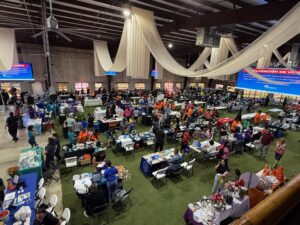
The event took place in October of 2025, drawing in upwards of 700 people and 65 vendors to the Rancho El Chema, a popular wedding and events venue on the Southside. Vendors delivered health screenings and vaccinations, dental checks, mammograms, kidney exams, and more.
While health and resource fairs often require months of planning and coordination, they offer a powerful way to connect communities with essential services in areas of high need. Southside Collaborative chose to host a fair in response to the Southside’s limited access to basic resources and community amenities.
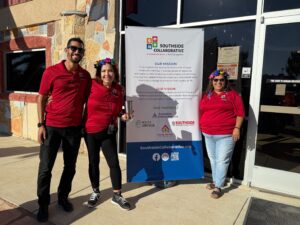
From left, Southside Collaborative’s Edward Castillo, Mayra Carter and Pat Sanchez.
“There’s a lot of food scarcity. There’s no HEB or Walmart in the area. There’s no VIA bus line. There’s no hospital. There are a lot of barriers to health and wellness,” said Edward Castillo, director of Southside Collaborative. “We decided to hold this event and try to recruit as many different vendors as possible to provide services, like free health checks.”
Given they started planning in summer, what Southside accomplished in a few short months even surprised the organizers. The momentum for the event really took off because of community involvement, Castillo said.
“I really think that this event, and the success of this event, was a beautiful example of what happened when our coalition worked in partnership with the community,” he said.
Southside Collaborative held it’s first-ever resource fair attracting more than 65 vendors.
Demonstrating the impact of providing accessible health services on site, one vendor discovered an attendee had a life-threatening condition during a kidney screening. They provided medication on-site and directed them to emergency follow-up, potentially saving a life.
While the event had a serious goal to provide health services, the organizers also put emphasis on fun to attract families. There was an array of family-friendly activities, music, a dance floor, giveaways, and mascots for the children.
This transformed the event from a “resource fair” into an experience, Castillo said.
Health Confianza asked Castillo and marketing expert Donna Prado, who works with Southside Collaborative, about some of the key ingredients that led to the success of their first health fair. Below are their key takeaways:
Takeaways from Southside’s first Health & Wellness Fiesta
Deep Community Engagement
The Community Advisory Board (CAB) played a central role—suggesting vendors, identifying venues, spreading the word, and giving real-time feedback on community needs. Community members were genuinely invested because they helped shape the event. And their involvement helped to build trust, credibility and buzz.
Boots-on-the-Ground Marketing (Critical in Low-Internet Areas)
Flyers were handed out at churches, laundromats, businesses, football games, community events, and door-to-door because the area has limited Internet access.
Volunteers saturated the area to the point people were saying, “I’ve already heard about this.” This saturation built positive familiarity and anticipation.
Strong Partnerships with Local Organizations
Southside ISD was a major amplifier: ads on their Jumbotron, distribution of flyers through school principals, and support from their print shop. Local businesses were engaged intentionally—buying food, printing shirts, hosting signs—building reciprocal relationships that made them eager to help.
Choosing a Compelling Venue
The event hall was large, beautiful, and carried local curiosity (“I’ve driven by but never been inside.”). This “buzz factor” drew people who simply wanted to check it out. Ample space and parking (though parking still became an issue!) made the event feel professional and inviting.
Making It Fun and Family-Friendly
They intentionally made the event feel like a fiesta. There were plenty of volunteer mascots (Sparky, Smokey the Bear, McGruff, etc.) There were fire trucks and other kids’ attractions, which in turn bring their parents. There were also free food tickets to keep families on-site longer
Wide Variety of Vendors and Services
They crowdsourced vendor ideas through a shared Google Sheet. Over 75 vendors signed up; ~65 attended. They also focused on offering high-value resources: mammograms, kidney screenings, vaccinations, and wellness information.
They did plenty of follow-up with vendors to ensure high attendance and planning accuracy.
Flexible, Multichannel Marketing Strategy
Southside spent $300 on targeted Facebook ads (English + Spanish), resulting in approximately 20K impressions. Telemundo showed up unexpectedly and even MC’d, providing major visibility. And print materials were produced affordably via Southside ISD’s print shop.
Thoughtful Logistics & Lessons Learned
What worked:
Evergreen marketing assets (no dates on banners so they can be repurposed).
Weekly planning meetings.
Good vendor communication and confirmation.
What they want to improve next year:
More organized parking (overflow + shuttles).
A dedicated event webpage with maps, schedules, and vendor lists.
Earlier planning (start in January, not July).
A more intentional digital communication strategy with vendors, supported by a shared social media toolkit and recommended hashtags to encourage consistent, coordinated promotion.
San Antonio, Tx — Imagine engaging with a community and rapidly learning what people are thinking and feeling about their health and well-being.
As a core function of public health, the capacity to quickly turn data into action is highly valued, but often difficult to realize. At least until now.
Health Confianza is piloting a technological solution called the Community Microphone that allows people to record responses to questions in real time using a cellphone. Their responses are then automatically transcribed and summarized using AI. Public health professionals can further use AI to analyze these data in real time to draw insights, ask questions, and find common themes among responses.
“Although the health priorities and determinants may be similar across Bexar County, each community has its own strengths and challenges that must be acknowledged,” said Jason Rosenfeld, DrPH, MPH, CHWI, co-director of Health Confianza, director of Global Health, The University of Texas at San Antonio. “The Community Microphone gives us a way to hear directly from community about their concerns and solutions, in a non-intrusive way, so that we as public health professionals can better, and more rapidly, tailor our interventions.”
The tool helps reduce the time and manpower typically needed for community assessments using traditional data collection methods like surveys or focus groups. Because this system is automated, the microphone can be used anywhere, anytime, and eventually, in any language.
However, as with any new strategy, there are challenges to consider. Community health workers, who shared the community mics via a QR code on flyers, said that it can be difficult for phone microphones to record responses in noisy environments, such as health fairs. Additionally, the technology only records voice, which may be difficult for those who have difficulty speaking. Lastly, not all community members have access to smart phones.
Health Confianza partnered with Flourish, a Houston-based data analytics company, on the community microphone, which is one tool in a Salesforce-powered dashboard created to collect, manage, share and visualize program data. The company offers the community microphone tool as part of a dashboard, or it can be purchased separately.
“Together, Health Confianza and Flourish are identifying best practices around the use of the voice-based data collection and AI analysis via the community microphone tool in public health settings. We are excited to see how this tool can be replicated in other communities and brought to scale for the purpose of centering community voice in programs aimed at improving health and wellness,” said Aaron Godoy, co-founder, CTO, CEO at Flourish.
Community Mic Drop
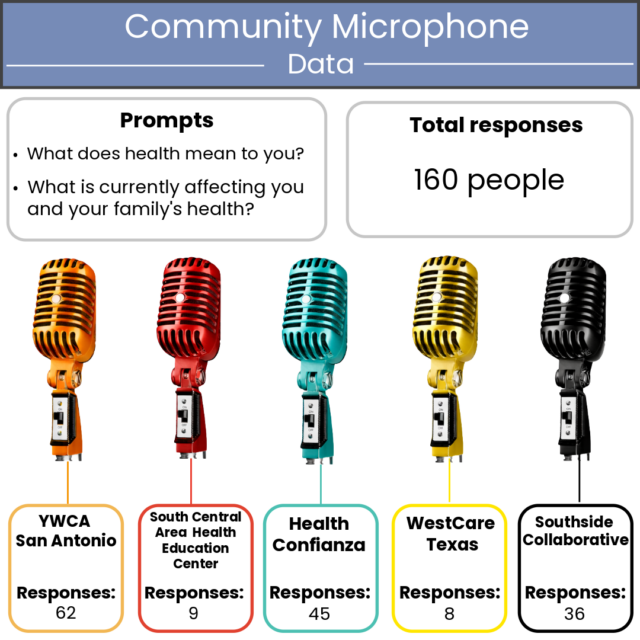
In April of last year, Health Confianza and its partners —South Central Area Health Education Center (AHEC), Southside Collaborative, WestCare Texas, and YWCA San Antonio —launched the first community microphone with two simple prompts in English and Spanish.
What does health mean to you?
What is currently affecting you and your family’s health?
From April through May, Health Confianza and its four partners gathered community input at health fairs, club meetings, bulletin boards, etc. These five organizations collected more than 160 responses from people across Bexar County.
Overall, here’s what the respondents said should be addressed to create a healthier community:
Improved access to nutritious food and healthcare resources
Community support, education and prevention
Support to manage chronic health conditions such as diabetes and hypertension
Safe neighborhoods; freedom from fear of gun violence
Greater social connections and communal spaces for healthier living
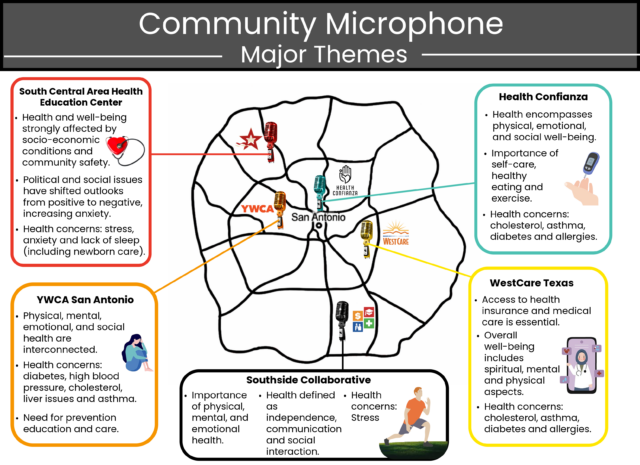
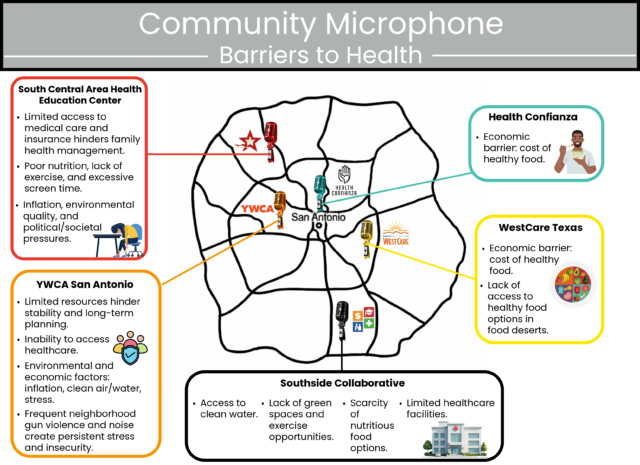
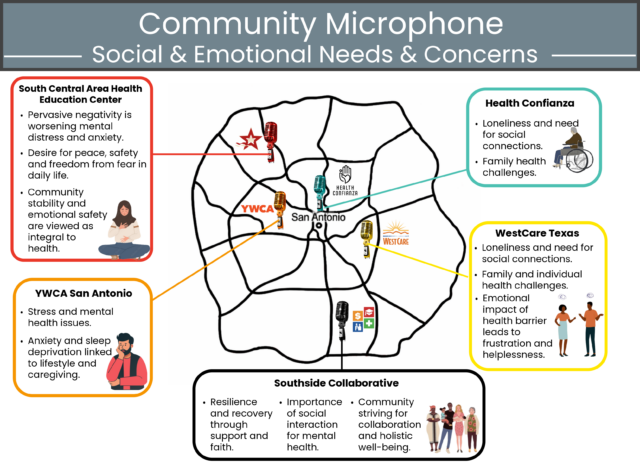
Health Confianza’s team also created three infographics summarizing community responses from San Antonio’s Westside, Southside, Eastside, Central and Northside. The infographics cover three areas: major themes, barriers to health, and social/emotional needs and concerns.
“With this information, we and our partners are able to more rapidly respond to the needs and priorities of the communities we serve. We feel that our tailored responses will contribute to an increase in trust between our organizations and our community, resulting in sustained utilization of our information and services. We are excited to continue centering community voice in our programming via the Community Microphone while seeking additional tools for building and sustaining community trust.” Rosenfeld said.
See the infographics highlighting community voices below.
Major Themes Highlighted by Community
Barriers to Health Noted by Community
Social and Emotional Needs and Concerns from Community
San Antonio, TEXAS – In a new commentary, assistant professors Melanie Stone and Jason Rosenfeld of The University of Texas at San Antonio are spotlighting precision public health, a concept that leverages technology to more efficiently transform the health and well-being of entire communities.
Originated over a decade ago, precision public health is defined as “a concept of using effective, fair, and reliable data and social enterprise to improve the health of all.”
The commentary, titled “Putting Precision Public Health into Action,” was published in the January/February issue of the Journal of Public Health Management & Practice.
“Through this commentary, we want to spur discussion around precision public health and draw attention to the innovative strategies and technologies available today to address a myriad of health care issues, including loneliness and chronic diseases,” said Melanie Stone, DrPH, MEd, co-director of Health Confianza, Assistant Professor of Family & Community Medicine and Director of Community Engaged Learning.
Stone and Rosenfeld point to Health Confianza, the five-year-old grant-fund initiative they co-direct, as an example of precision public health. Health Confianza is a multilevel health literacy program designed to address health literacy at the organizational, professional, and individual level.
“Health Confianza is leveraging data/AI tools, digital communications and strategic partnerships to measure, target and quickly respond to community’s needs with the goal of increasing the use of preventive health services, public trust in health systems and overall well-being,” said Jason Rosenfeld, DrPH, MPH, CHWI, co-director of Health Confianza, director of Global Health.
The ability to practice precision public health has taken on a new relevancy as health insurance and care costs continue to rise.
“With budget and workforce constraints, we need to prioritize the utilization of the tools and strategies that precision public health offers to address these ever-evolving health challenges,” Stone said.
By Dr. Melanie Stone, DrPH, MEd, co-director of Health Confianza, Assistant Professor of Family & Community Medicine and Director of Community Engaged Learning.
As we close out 2025 and step into a new year, many of us are reflecting, setting goals, and recommitting to our health and well-being. But a critical question remains: How do we ensure everyone in our community has a real opportunity to be healthy?
At Health Confianza, we believe the answer starts with health literacy—making sure people can access, understand, and use health information and services. Every day, our neighbors are flooded with information, yet too often left unsure how to act on it. We’re working to change that.
In this issue, you’ll see how we’re reimagining health communication in creative and human-centered ways. Our Health Confianza ambassadors are gathering community input through conversation and the joyful act of coloring—creating space for authentic voices to be heard. At the same time, we’re exploring innovative tools like artificial intelligence, using a virtual “community microphone” that allows people to speak freely and have their insights instantly summarized.
Together with partners like the YWCA, we’re launching maternal health clubs that support peer-to-peer learning throughout pregnancy and new motherhood. We collaborated with marketing experts to create a local preventive health campaign that makes staying healthy both easy and fun.
Through our strong partnership with Southside Collaborative, we celebrated their first-ever health fair that drew more than 700 community members.
Additionally, we completed a Learning Collaborative with seven local organizations now applying organizational health literacy principles to improve how clients experience their services. And this fall, our ECHO telementoring series brought health professionals and community health workers together to strengthen plain-language communication—highlighted by Dr. Matt Dacso’s practical approach to discussing genetics.
As Dr. Jason Rosenfeld shared in our first issue, this work is about leading and communicating with confianza—confidence grounded in trust, knowledge, and unity. As we move into the new year, we’re grateful to be part of this growing Confianza Collective and excited to continue innovating together to help individuals and families make informed decisions that support lifelong health.
San Antonio, Texas — Given the abundance of health information available online and through technology, patients and clients are asking complex questions about their health that are pushing health professionals and community health workers to sharpen their health communication skills.
Some common questions may include, “‘My father had a thyroid problem. I assume I’ll have one as well. Should I get tested? Or everyone in my family has had a bad reaction to vaccines. Will I have a bad reaction?,’” said Matt Dacso, MD, MSc, FACP, director of the Charles E. Cheever Jr. Center for Medical Humanities & Ethics and professor of medicine.
Today it’s not unusual for a health talk to touch upon genetics, environment, lifestyle, and testing, and how they all interact to influence health, he added.
Dr. Matt Dacso
As such, there is a growing need for health communication strategies to help professionals navigate this complex information environment, Dacso said. He tackled the topic in a Health Confianza ECHO presentation titled, “Genetics are Not Always Destiny – Communicating the Complex Relationship Between Nature and Nurture.”
“We have greatly expanded our knowledge about what genetics, what our DNA, does for our bodies and what it does for our risk (for disease),” Dacso said. “And we also are constantly learning more about how lifestyle, how environment, how socioeconomic conditions play with the DNA and affect our bodies in a way that actually can cause health conditions to integrate into our health and our next generations.”
Technology and its rapid evolution are also adding complexity.
“This influx of health information can be very hard for our patients, clients or members of the community who are just trying to figure out what to do for their health,” he said.
What this means for health providers/community health workers
Today, conversations around health require layered and thoughtful consideration of multiple factors: genetics (individual genes and inheritance), genomics (the interaction of multiple genes and environmental factors), as well as the role of social determinants of health, Dasco said.
“We have to figure out how to communicate with our community about how complex this is,” he said.
When weighing risks for certain diseases and illness and assessing the next steps, experts look at social determinants, such as stress.
“We know from adverse childhood events literature that there are potential limitations or delays in developmental milestones for youth that are living in poverty or in situations of lower socioeconomic status,” he said.
It’s also important to recognize that when a health professional is talking about what the environment is doing to an individual’s genes, they are discussing Epigenetics — the study of how environmental stressors (such as diet, stress and toxins) can turn on or off certain genes influencing development, health, and disease, he said.
“The point here is not that we need to be experts in genetics. It’s to show that there’s actual science behind what people say and what they feel,” Dacso added.
While some diseases are purely genetic, including sickle cell and Huntington’s disease, other health conditions illustrate varying degrees of genetic and environmental influence— complex conditions like diabetes, cancer, and autoimmune disorders.
Another consideration for health practitioners is that patients and clients are on the receiving end of a flood of health information from technology and AI platforms.
For instance, direct-to-consumer genetic testing has yielded unprecedented access to health information, which offers individuals empowerment but also raises concerns about interpretation, cost, and privacy.
Even with the availability of health information, health providers should keep in mind that the average health literacy level in the U.S. is low. A large majority of adults (around 88%) at some point struggle with tasks like understanding medication instructions or health insurance information.
How to communicate uncertainty and risk effectively
When having conversations with patients and clients, it’s good to point out that medicine is inherently uncertain, said Dacso, quoting William Osler: “Medicine is a science of uncertainty and an art of probability.”
“When you are transparent about what is known, unknown, and subject to change, you are able to build trust,” Dacso said. “The main message is that patients can understand uncertainty if it is explained honestly and clearly.”
People accept risks more readily when they understand the benefits and are part of a shared decision-making process.
“They want to make the best decisions for themselves or, when caring for others, for their loved ones. But the amount of information can feel overwhelming,” Dacso said.
Overall, Dacso said, “Have awareness, empathy, humility, transparency, and then empower the people who are around us.”
Watch Dacso’s video here and see tips and resources below.
Practical communication strategies from Dr. Dacso include:
Present information in multiple formats — (e.g., percentages and frequencies), avoiding framing bias, and using relatable denominators (e.g., “1 in 10” instead of “1 in 10,000”).
Remember, less is more — avoid overwhelming patients with technical details unless they ask. Emotional factors often distort risk perception, so empathy and reassurance are key.
Use Visual tools like the Swiss cheese model, which was popularly used to explain the COVID-19 pandemic, and simple risk charts to help make complex concepts understandable.
Genetics – The study of how parents pass certain genes to their children
DNA – A tiny substance that has instructions for making every part of you
mRNA vaccine is also known as: messenger RNA vaccine — A new type of vaccine to protect against infectious diseases where parts of your DNA (chemical makeup of cells) are taught how to create a protein
Social Determinants – Also known as: health disparities
Conditions that may influence a person’s risk for developing health problems and health outcomes. Social determinants of health include where a person: lives, works, learns and plays
By Dr. Junda Woo, Medical Director and Local Health Authority, San Antonio Metropolitan Health District
Sandra Zaragoza, Senior Marketing and Communications Specialist, Health Confianza
San Antonio, TEXAS — As respiratory virus season approaches, health professionals and community health workers will be working in a shifting vaccine landscape. While guidance and rules may change, the collective goal stays the same – providing access to vaccines and scientifically accurate, evidence-based guidance to support people’s health decisions.
To help navigate this challenging time, here are some insights and resources.
Who is Eligible for COVID vaccines?
The U.S. Centers for Disease Prevention & Control (CDC), U.S. Food and Drug Administration leaders and medical societies all agree that an annual COVID vaccination is recommended for people at risk for severe illness and people ages 65 and older.
Where they differ is in recommendations for COVID shots for the following populations: healthy adults under 65, pregnant people and healthy children. Part of the reason is that we collectively have more immunity, from infections and vaccinations, than we did in years past.
We are still waiting for 2025-26 CDC recommendations. For 2024-25 (as of September), see the box below.
Annual COVID Vaccine Recommendations (As of Sept. 2025)
Because the differences in guidance may be confusing, think about encouraging your patients and clients to engage in shared decision-making with their health care providers. Shared decision-making is where patients and clinicians collaborate to make healthcare decisions, considering both medical evidence and the patient’s own values and preferences. An example of shared decision-making is when parents choose to vaccinate their child after discussing it with their healthcare provider.
Less Convenient, More Expensive
Unfortunately, as of Oct. 1, Texas’ Adult Safety Net program will stop covering COVID vaccines for people who are uninsured. We are awaiting news about the Vaccines for Children program coverage.
Insurers seem likely to cover COVID vaccines for everyone until Jan. 1, 2026, when the new benefit year begins.
Access to vaccines at pharmacies will vary by state (map). Fortunately, Texas pharmacists will give the vaccine. For people who pay out of their own pockets, discount coupons can lower the cost.
For people at risk for severe illness who cannot access the vaccine, the old standbys still work: clean air, handwashing, staying away from others who are sick, masking, getting tested.
Counseling and Consents Are Changing
In June, the FDA expanded the myocarditis warning on mRNA vaccines. mRNA vaccines have been linked, rarely, to myocarditis and pericarditis—inflammation of the heart muscle and tissue.
The reaction is most common in males ages 12 to 24, occurring in 27 of every 1 million doses. To lower this risk, the CDC suggests spacing out 1st and 2nd doses by 8 weeks in young men. Importantly, COVID infection and disease also can cause heart conditions.
When obtaining a COVID vaccine, patients may be asked to sign a new informed consent form that was required by the Texas Legislature (HB 4535).
Vaccines for Children
The American Academy of Pediatrics (AAP) published its own evidence-based immunization schedule for children in August. The schedule offers recommendations on RSV, flu and COVID, as well as other key vaccines.
What’s New with Flu Vaccines?
Metro Health continues to promote the importance of flu vaccines in reducing severe illness and hospitalization, especially in people who are immunocompromised, children and elders. Last season, 275 U.S. children died from the flu, and 90% were not fully vaccinated.
Starting this fall, multidose vials of flu vaccine no longer will contain thimerosal. Thimerosal is an FDA-approved antifungal/antibacterial that was only in multidose flu vials (4% to 7% of flu vaccines). It is not in any routine childhood vaccines.
You may see ads this fall for a self-administered, at-home nasal spray vaccine. Unlike flu shots, the nasal spray uses a form of the live virus (weakened) and so is not recommended for pregnant or immunosuppressed people, among others. It is approved for ages 2 through 49 and could be a good option for people with needle phobia.
How is Metro Health Navigating the Conflicting Guidance?
As vaccine expertise and advice change on a federal level, old-school science-based recommendations will continue through medical specialty societies and new coalitions. Metro Health will monitor the evolving landscape and share credible information with our community as we receive it. Subscribe to Metro Health’s clinician newsletter here.
By Jason Rosenfeld, DrPH, MPH, CHWI, co-director of Health Confianza, director of Global Health, The University of Texas at San Antonio.
Hi everyone and welcome to the third installment of our Health Confianza newsletter. As I was reflecting on what I wanted to say this quarter, I came to the realization that our country is embarking on sweeping changes to public health policy, research funding, and the social safety net, bringing our city, county and collective work to a critical moment. The recently passed One Big Beautiful Bill Act is expected to reshape healthcare access and public health services nationwide, including changes to Medicaid and food assistance programs. In Bexar County, where many residents rely on these programs, these developments will bring both uncertainty and fear—and they call on us, as community leaders, to respond with clarity and compassion.
At Health Confianza, we believe that trusted relationships and informed action are the foundation of building and sustaining community resilience. To best prepare our diverse San Antonio community for these changes, we feel it is time to reaffirm our shared responsibility and collective efforts to ensure people have access to the most accurate, timely, and trustworthy health information. By applying principles of health literacy—such as plain language, cultural relevance, and active listening, we can help reduce fear, build confidence, and empower our neighbors to make informed decisions about their health and well-being.
To this end, this issue of our newsletter is full of information and resources to help us navigate this changing landscape. This includes up to date vaccine guidance and recommendations from Dr. Junda Woo, a primer on how to integrate plain language into health communications, an introduction to our new cohort of trusted community collaborators and messengers known as Confianza Ambassadors, a profile on a Confianza Community Changer from the Southside, and an overview of our upcoming Communicating with Confianza ECHO series.
Together, we can be a steady source of clarity and support in uncertain times. Let’s continue to lead and communicate with confianza—confidence rooted in trust, knowledge, and unity. Thank you for being part of our Confianza Collective where we work towards helping people make the best decisions for themselves and their families.
Sign up for the Health Confianza Quarterly newsletter: https://forms.office.com/r/jMN7m52Wit
By Sandra Zaragoza, Sr. Marketing and Communications Specialist, Health Confianza
Melanie Stone, DrPH, MEd, Co-director of Health Confianza, Assistant Professor of Family & Community Medicine and Director of Community Service Learning, The University of Texas at San Antonio
San Antonio, TEXAS — Health communications are an ever-present part of our daily lives — a flyer at a health fair, an in-take document at the doctor’s office, a wellness TikTok, an infographic, or a written follow-up we receive from our health provider.
While health communications are around in different forms, they may be filled with medical jargon, complex sentences and hard-to-follow guidance.
In short, they may not be written in plain language. Plain language is defined as communication with clear wording, structure, and design for the intended audience to easily:
– find what they need
– understand what they find
– use that information
Increasingly, the health care and nonprofit communities are recognizing the important role of plain language in removing barriers to health care, enhancing patient safety and increasing the patient’s ability to make informed health decisions.
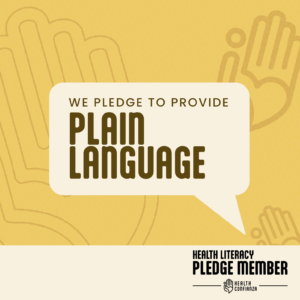
A social post for Health Confianza’s Pledge Program promoting the use of plain language.
At the same time, training in plain language communication is not a part of standard education for health care providers, which means plain language must be intentional.
Fortunately, we are beginning to see more health providers, community health workers and health communicators learning plain language skills and making this a communication priority in their organizational policies and practices.
Spotting the Mistakes
One of the easiest ways to start employing plain language is to be able to spot when it doesn’t meet the standards. To that end, the Institute for Healthcare Advancement (IHA) created a list of the 10 most common errors that health providers make when communicating with patients.
IHA points out that health providers tend to create prescription instructions “that are written at an 11th grade reading level or higher, rather than 5th grade reading level at which the majority of the country’s population reads.”
Another common error, according to IHA, is handing out reading material that is printed in a font size too small for the patient, particularly seniors. The type should be at least 12-point font with adequate space between lines.
Additionally, the power of graphics is often overlooked when creating materials, according to experts.
IHA points out that simple visuals for medical instruction can enhance patient understanding. However, they warn that graphics should demonstrate and explain concepts in the text and should never be abstract or for decorative purposes only.
Overburdening patients with numeracy skills is another area to be mindful. Providing context for numbers (use 1 in 5 versus 20%), removing the need for the reader to perform calculations, and using appropriate visuals can help improve plain language numeracy.
Unfortunately, mistakes in health communications come with both a human and financial impact, with an estimated $236 billion in unnecessary health care expenses annually due to the inability of patients to understand what medical providers are communicating to them, according to a 2008 article in Nurse Educator.
The good news is that there is guidance, techniques and tools that encourage the use of plain language.
History of Plain Language
The Plain Writing Act of 2010 requires federal agencies to train staff to use plain language when they communicate with the public. As part of that act, the federal government offers plain language guidance.
Among the most common techniques for achieving plain language:
Reader-centered organization
“You” and other pronouns
Active voice, not passive
Short sentences and paragraphs
Common, everyday words
Easy-to-follow design features (lists, headers, tables)
Additionally, The Center for Plain Language offers 5 Steps to Plain Language that each include more detailed information:
Identify and describe the target audience
Structure the content to guide the reader through it
Write the content in plain language – keep it short and to the point
Use information design to help readers see and understand
Work with the target user group to test the design and content
Health literacy experts recommend that health professionals initially introduce the medical term that the patient will encounter (e.g. myocardial infarction), immediately followed by the plain language version (e.g. heart attack). This will help the patient connect the terms. Also, use analogies the patient may be familiar with to help make the medical concept clearer, such as the mechanics of a car representing your cardiovascular system.
How to Check if it’s Plain Language
There are paid and free tools that can help a health communications professional review and assess adherence to plain language principles.
While technology can be a useful tool to enhance plain language (e.g. using a chatbot to write your information in a conversational tone), a human editor is still needed to check for accuracy, potential misunderstandings, and overall use of plain language principles.
Keeping Plain Language Top of Mind
One way to keep an organization or team thinking in terms of health literacy and plain language is to make sure they have access to trainings, refresher courses and webinars.
The U.S. Centers for Disease Control & Prevention, the Center for Plain Language, Health Confianza are just some of the organizations that offer affordable health literacy education.
“Communication is only effective if the receiver actually comprehends the message sent,” said Melanie Stone, DrPH, MEd, co-director of Health Confianza. “I often remind health care professionals, ‘What’s the point of your medical knowledge if you cannot convey it to the person who needs it?’ I challenge our trainees with the quote from Albert Einstein, “If you can’t explain it simply, you don’t understand it well enough.” Plain language helps ensure people understand what you are saying the first time you say it.”
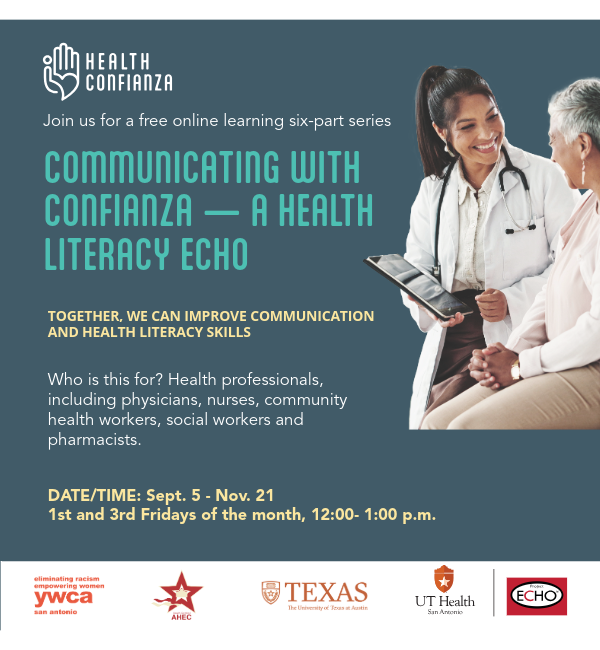
San Antonio, TEXAS —This fall, Health Confianza is offering “Communicating with Confianza – A Health Literacy ECHO,” a free six-part virtual professional development series on the practical use of health literacy strategies and tools in the workplace. Health Confianza is a four-year old health literacy initiative funded by Bexar County and housed at The University of Texas San Antonio.
Designed for health professionals, including physicians, pharmacists, nurses, community health workers, and more, the series will focus on using health literacy principles in interactions with patients/clients to achieve improved communication and understanding.
The ECHO (Extension for Community Healthcare Outcomes) uses an “all teach, all learn” learning model to develop a virtual community of peers who learn from experts and share best practices with each other. The “Communicating with Confianza” ECHO,covers the following topics: Acknowledging perspectives, stigma, creating a shame-free environment, plain language, shared decision-making, and teach-back.
Participants will learn evidence-based strategies for improving health literacy, ways to convey culturally-sensitive health information, and how to build trust through communication.
Health Confianza will host the series from Sept. 5 through Nov. 21, 2025, on the first and third Fridays of the month from 12 to 1 p.m. Free continuing education (CE) credits are available.